


Art & Culture Connecting Countries: Nepali Temple in Varanasi
- alabhyapandey23
- Jan 15, 2022
- 2 min read
Updated: Dec 4, 2022

In 1800 C.E. Rana Bahadur Shah who succeeded the throne of Nepal after the death of his father King Pratap Shing Shah lodged in the great wen of Kashi under exile. Kashi, also referred to as Varanasi, was the domain of his guardian deity Pashupati who is lord of the beasts himself. Lord Shiva is recognised as Pashupati in Atharvaveda: a Hindu scripture. He adopted the title of 'Swami Nirgunananda' here and decided to establish a replica of the Pashupatinath Temple, the most pious and sacred place of worship in the capital of modern-day Nepal, Kathmandu. This shifted an immortal embodiment of Kathmandu to the banks of saintly Ganges from the bank of holy Bagmati.
The Resemblances allying two can be observed in the area selected for the construction by the king himself. Nepal's Pashupatinath temple lies in the vicinity of Bagmati and the holy cremation area of Kathmandu. And to create the same ambience around the miniature replica, an area between Lalita ghat and Manikarnika ghat (an area of holy cremation on the bank of Ganges).
Construction started while his stay in the city from 1800 to 1804. Later he returned to rule Nepal again in 1806 but soon after that his stepbrother Sher Bahadur Shah stabbed him and construction was paused for a while again. After that, his son Grivan Yuddha Bikram Shah succeeded him and took the initiative to complete the construction. Finally, construction was completed after almost forty years and the land of that area was granted to the king of Nepal by Kashi Naresh (Ruler of Kashi) in 1843.

Temple still stands at the height of 50 feet, above the ghats of the Ganges from its base stone. Also, it is identified by its mesmerisingly unique structure that stands out among the domes and spires which dominate the skyline of Kashi. Terracotta, woods of the Sheesham and Shenhua trees (bought from Nepal itself to make it termite resistant) and stones are used as major building materials. Both temple and a Dharmashala (shelter for pilgrims) situated alongside are painted with red and black colour.
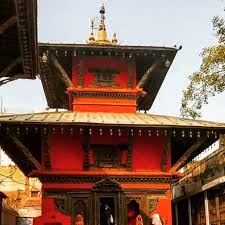






If we look further in detail, the temple is built in a native Nepalese Pagoda-Style of architecture, with many roofs by the artisans of Nepal. It also has a sculpture that has Carvings alike the Khajuraho group of monuments. Thus, this place unifies three significant cultures of Nepal (specifically Kathmandu), Kashi and Khajuraho together.
It later became popular with several names, including 'Nepali Khapra' an identity of Nepalese culture in Kashi with Shri Samrajeswar Pashupatinath Mahadev Mandir, Nepali temple/ Kanthwala temple/ mini Khajuraho with a dharmshala and Siddhagiri Mutt (also called as Rajrajeshwari temple).
Its grandiosity is still witnessed, acknowledged and admired by many visitors, photographers and culture & heritage enthusiasts. This area also enacts as a binding force between two countries. Many Nepali people and even some political figures spent their lives hereafter in exile. Also, the temple and surrounding area are still managed by the government of Nepal. If you ever visit Varanasi, make sure to track and trap this unique structure on your tour!


While reading this, you actually travel a journey from Pashupatinath, Kathmandu to Varanasi bhumi. A wonderful piece that uncovers something unique about amalgamation of different cultures. Pictures of kathkhuni with clear details do motivates u to visit the place. Thanks pandey