


The Mansion of the Lord!
- alabhyapandey23
- Jan 12, 2023
- 4 min read
There is a small town called Nathdwara in the state of Rajasthan, India. Nathdwara lies 48 km northeast of Udaipur on the right bank of the Banas River, at a distance of 48 kilometres. But what makes this little place so auspicious? And why is it an important centre where faith flourishes with wealth?
Before seeking the answer to the questions raised above, even I very recently got wised to this place, when one of my school friends Arpan shared his pilgrimage experience with me, there was an inquisitive urge within that hankered me to learn more about the ‘Gates of the Lord’ itself. I guess it was my pity that I learned about this place lately, but felt connected ever since I took its cognizance. Thus, I decided to draft this blog, just in case it will find others who are being called by the Spirit of all the spirits.
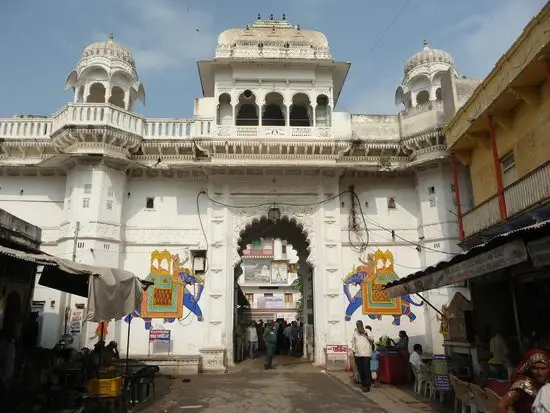
Shrinathji used to go to Mewar to play chaupar, a game that predated Parcheesi, with a princess by the name of Ajab Kunvari, according to the hagiography of the Pushtimarg. When her beloved Shrinathji would return to Vraj, she would become distraught and would want him to stay with her in the palace. When the time was appropriate, Lord Shrinathji said he would move to Rajasthan. Consequently, descendants of Vallabhacharya worship Shrinathji at a haveli in Nathdwara, Rajasthan. The temple was known as the Haveli because it was housed inside a walled residence that was originally the Sesodia Rajput lords of Mewar's grand palace, or Haveli.

According to the legend, the image of Lord Shrinath ji was enshrined in Vrindavan (land of Lord Krishna/ Forest of Tulsi (Basil), Mathura. Mughal ruler Aurangzeb was keen to keep the prestigious deity with him in Agra, so the image was initially moved from Mathura in 1672 CE along the river Yamuna to Agra for almost six months. To conceal the image from the Mughal ruler Aurangzeb, the image was then transported on a chariot further south. A spot in village Sihad or Sinhad is said to have been impassable when the image was being moved and the wheel of the vehicle sank into the mud. After refusing to move further, the escorting priest concluded that this was the location chosen by the Lord. Meanwhile, Maharana Raj Singh of Mewar was in charge and guarding the territory, a temple was constructed there. In 1672, Goswami Damodar Das Bairagi established the temple here.
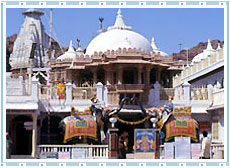
The temple's apex is marked structurally by a kalasha on the shikhara, where seven flags and the Sudarshana Chakra are flown. The seven flags stand for the seven "houses" of Vallabh Sampradaya or Pushti Marg. The temple is also known as Shrinathji ki Haveli in popular culture (Mansion of Shrinathji). As Shrinathji is not viewed as an impersonal deity in Pushti Marg, worship is not conducted in the manner of a temple. Sewa (service) is provided in lieu of worship to Shrinathji, who is regarded as Thakorji or Lord of the House or Haveli. The temple was created in the style of Vrindavan's Nanda Maharaj Palace, which is home to Krishna. Consequently, it also goes by the names Nanda Bhavan and Nandalaya (the House of Nanda).
Particularly in comparison to a typical home, it has a chariot for mobility (actually, it was the original chariot used to transport Shrinathji to Singhar), a room for milk storage (Doodhghar), a room for betel storage (Paanghar), a room for sugar and sweetmeat storage (Mishrighar and Pedaghar), a room for flowers storage (Phoolghar), a room for cooking (Rasoighar), a drawing room (Baithak), a treasury (Kharcha bhandaar), a stable for chariot horses (Gahnaghar), a gold and silver grinding wheel (Chakki). This shows the intense donations and fundings the site receives from its followers.
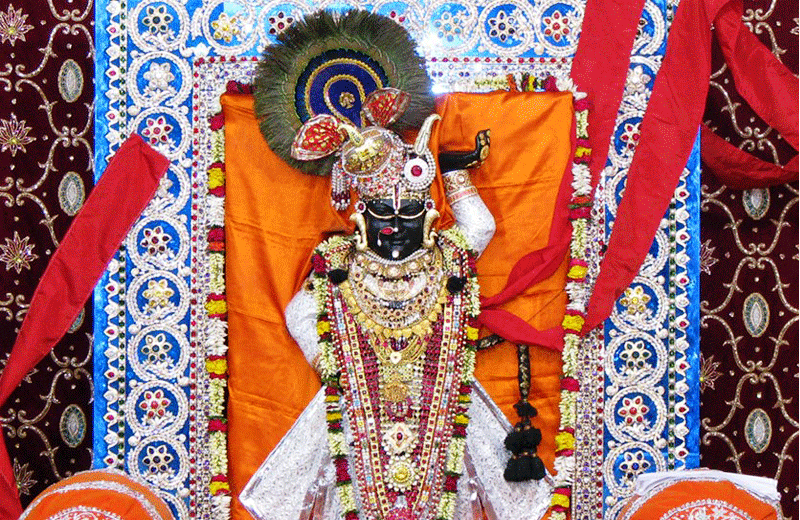
When he hoisted the "Govardhana," Lord Shrinathji represented a form of Lord Krishna (a hill). The artwork shows the lord with his left hand raised and his right hand made into a fist. A sizable black stone was used to sculpt the idol. By the god's head, the idol bears imprints of two cows, a snake, a lion, two peacocks, and a parrot.
Aartis and Shringar, or the dressing and beautifying of Shrinathji's deity, which is changed seven times a day, are the main draws. They involve treating the deity like a living being and dressing it in the proper attire depending on the time of day or night. A significant amount of genuine valuable jewellery is also present along with the finely woven shaneels and silk fabric. Depending on the demand of the time and occasion, formal prayers are offered with diya, incense sticks, flowers, fruit, and other offerings, along with local instruments and Shrinathji devotional songs. Jhakhi refers to the deity's appearance after the parda (curtain) has been taken down. People swarm the area in great numbers during the holidays of Holi, Diwali, and Janmashtami, which causes it to become crowded. In addition to celebrations like Holi and Janmashtmi, the temple celebrates Annakutta, a significant holiday, with great vigour and zeal.
The town of Nathdwara is also known as the Apollo of Mewar. The Shrinathji temple is the main attraction in Nathdwara, but the town is also known for its 'pichhwai' paintings, ivory articles, and delectable sweets. Pichhwai, also known as pichwai, pichhavai, pichhvai, pechhavai, and so on), etymologically "that which hangs from the back" from the Sanskrit words "Pichh" means back and "wais" means hanging, are large devotional painted pictures of Krishna, usually on cloth. Aside from artistic appeal, the purpose of pichhwais is to narrate Krishna's stories to the ill-informed. The Nathdwara temple has set with various images that shift according to the calendar of festivals honouring the deity.

I came to know about this place when I discovered that Madhurashtakam, composed by Sri Vallabhacharya ji, is quite popular and has some roots in the Udaipur district of Rajasthan. As soon as I started discussing the same with my friends, I was amazed to know about this intriguing place I wasn't acquainted with. This spot upholds a must-visit place in my travel plan since one must visit this temple to feel spiritual euphoria.


Comments